Align one repository across the trust path
I adapted the repository identity across the integrated system in the canonical-identity commit. The patch changes the source that Argo follows, the workflow subject that Kyverno accepts, the provenance source it expects and the repository recorded in the image metadata. Those fields describe different decisions, but they must refer to the intended project.
This is an integration story. The existing application/security and infrastructure/runtime components came from upstream repositories; the change makes their retained contracts agree with the canonical monorepo. The explanation of why alignment matters below is retrospective engineering analysis.
- Before
Mixed repository references
- After
Canonical repository bindings
- Evidence boundary
Configuration does not establish applied remote protections.
Text equivalent and limits
- Mixed repository references
- Canonical repository bindings
- Configuration does not establish applied remote protections.
Read the labeled relationships as the stated contract. Optional connections are dashed and explicitly labeled; comparisons do not imply a sequential handoff. This figure explains inspected code or recorded observations, not current cloud execution.
The source problem
Section titled “The source problem”Before the patch, several strings still identified the upstream application repository. Moving code into a canonical repository does not automatically change those expectations. Argo can follow the wrong Git source, while a verifier can reject a correctly produced artifact because its configured signer or source URI describes another repository.
The final policy expects the reusable signing workflow at the canonical repository on main. Its provenance rule expects the canonical Git source URI. The two Argo Applications use the canonical repository as their Git source. These are explicit configuration contracts, not a consequence of who owns the website.
What I changed
Section titled “What I changed”| Contract | Concrete patch |
|---|---|
| Image claim origin | Change all three policy keyless subjects to the canonical sign-attest.yml workflow on main. |
| Provenance source | Change the policy and predicate fixture to the canonical repository/main URI. |
| Desired-state source | Change both Argo Application repository URLs to the canonical monorepo. |
| Image source metadata | Change the Dockerfile OCI source label. |
| Maintenance ownership | Adapt CODEOWNERS, Renovate assignees/reviewers and parameterized root GitHub ruleset configuration. |
| Standalone manifest syntax | Correct malformed @shasha256 to @sha256. This retained manifest is separate from the active Helm release. |
The patch also updates four historical audit/status/handoff records. These document the integration work, but a written pass result is different from a freshly executed check.
Retained behavior and later context
Section titled “Retained behavior and later context”The baseline retains the canonical Argo source and policy expectations. Argo still follows main; this patch does not pin GitOps to the historical tag. Likewise, the certificate subject names a main-bound workflow rather than an immutable workflow revision.
The later Argo details capture provides context for the configured repository and selected digest. It is not execution evidence for every file in this commit.
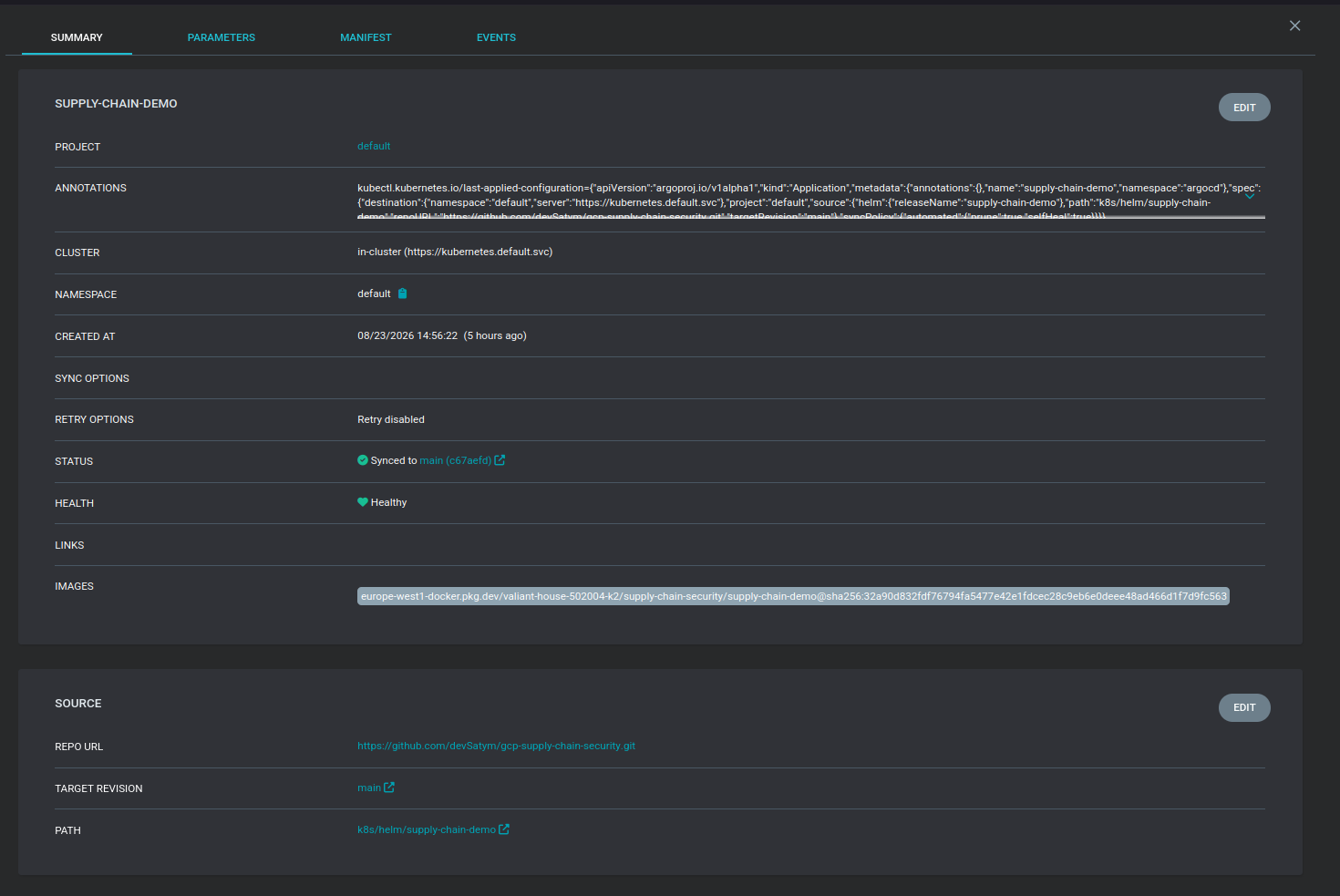
Evidence boundary: GitOps sync revision is distinct from the artifact build revision. Argo health does not cryptographically authenticate the image.
That capture belongs to the owner-recorded 23 August 2026 collection and shows current sync c67aefd. Its source and artifact fields must not be turned into the authoring commit of the image or a current health claim.
Trade-off and lesson
Section titled “Trade-off and lesson”A canonical identity is useful only when its consumers agree. My lesson from the inspected patch is to review repository migration as a set of trust and reconciliation contracts: signer subject, provenance source, GitOps source, metadata and ownership configuration each need deliberate attention.
This commit does not tighten the GCP Workload Identity provider’s cloud condition, create the verifier reader account or prove remote rulesets were applied. Those are separate changes or unverified operating facts. A forked reproduction also cannot simply reuse the canonical main-bound identities without rebinding the contracts in an owned environment.
Inspect the pinned upstream and merge record for component provenance, then read the separate verifier-access change to see how configuration identity becomes registry authority.