Give admission the reader identity it needs
I added the admission verifier’s registry access in the Kyverno reader-access commit. Kyverno needs access to the application registry and the artifact’s signed statements. The patch gives that consumer its own reader service account and connects the admission-controller Kubernetes identity to it through GKE Workload Identity.
This story is directly supported by IAM and Helm source. Historical admission captures show the surrounding system accepting and rejecting requests, but they are not isolated tests of each IAM binding.
- Before
Verifier registry access gap
- After
Separate reader for image and metadata stores
- Evidence boundary
IAM intent is code-inspected, not isolated impersonation proof.
Text equivalent and limits
- Verifier registry access gap
- Separate reader for image and metadata stores
- IAM intent is code-inspected, not isolated impersonation proof.
Read the labeled relationships as the stated contract. Optional connections are dashed and explicitly labeled; comparisons do not imply a sequential handoff. This figure explains inspected code or recorded observations, not current cloud execution.
Two stores, one verification decision
Section titled “Two stores, one verification decision”The application GAR repository has immutable tags. Cosign v2’s legacy signature and attestation indexes use a separate mutable metadata repository. The admission policy points to that metadata repository while statements remain bound to the application image digest.
A reader with access only to the application repository still lacks the metadata-store access required by this policy. That storage dependency is the engineering reason for inspecting both repository bindings. It is retrospective analysis of the source relationship, not a claim that an undocumented outage occurred.
What I changed
Section titled “What I changed”In the supply-chain foundation, I added the Kyverno verifier Google service account and reader roles on both repositories. A Workload Identity binding permits the named admission-controller KSA in the kyverno namespace to impersonate it.
The Helm values annotate that controller’s service account with the corresponding Google identity. The Terraform output exposes the verifier identity for configuration inspection.
| Identity | Defined authority |
|---|---|
| GitHub CI service account | Writer on the application and Cosign metadata repositories. |
| Kyverno verifier service account | Reader on both repositories. |
| Admission-controller KSA | Workload Identity impersonation of the verifier GSA. |
| Keyless signing workflow | Separate Sigstore certificate identity; not either Google service account. |
The annotation and impersonation member must agree. Source definitions make that relationship reviewable; they do not demonstrate the effective remote IAM policy or installed KSA at an arbitrary later date. This path creates no JSON key.
Supporting historical observation
Section titled “Supporting historical observation”The trusted capture shows server-side dry-run acceptance for the selected 32a90d… workload, followed by a separate live query showing available replicas. It supports an operating admission path in that historical context.
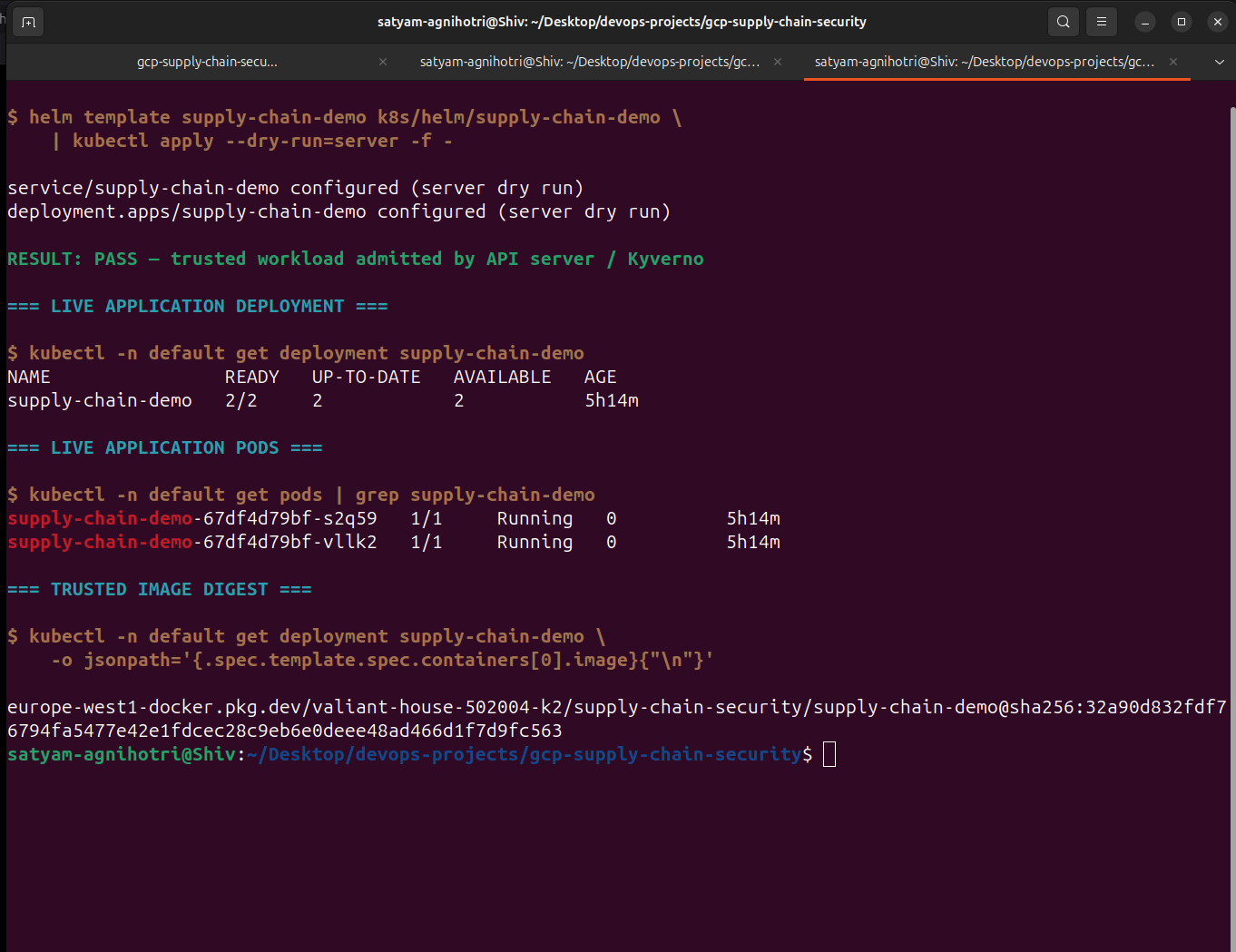
Evidence boundary: Dry-run does not create the separately listed replicas. Installed policy and artifact build revisions are not established by this image.
It does not isolate whether each repository role was necessary, identify an IAM token exchange, or establish the exact installed policy revision. The acceptance comparison includes the paired unsigned rejection and its request limits.
Trade-off and lesson
Section titled “Trade-off and lesson”A separate reader identity limits the verifier’s storage authority: admission needs to fetch claims rather than publish them. CI’s verification job still authenticates with the broader writer account in this baseline, so the separation should not be described as universal read-only verification.
Read access is also an availability dependency. Deleted metadata, registry authentication failure or unavailable webhooks can disrupt verification without making an untrusted signature valid. Policy Enforce alone does not prove webhook outage handling; those cases remain in the evidence gaps.
The lesson is to treat verifier access as part of the admission contract: image pattern, metadata address, KSA, GSA annotation and both repository permissions must line up. Diagnose a retrieval failure separately from a successfully retrieved statement that fails trust checks.